
Ghadir Khumm: The Day That Changed Islamic History
In the final year of his life, Prophet Muhammad performed what became known as the Farewell Pilgrimage. After completing the pilgrimage, he and the large group of Muslims who had accompanied him began their journey back toward Medina.
On 18 Dhu al-Hijjah, 10 AH, the Prophet stopped at a place known as Ghadir Khumm, near al-Juhfa, where different groups of travelers would separate and continue toward their respective destinations.
It was at this location that one of the most significant declarations in Islamic history took place.
The Gathering at Ghadir Khumm
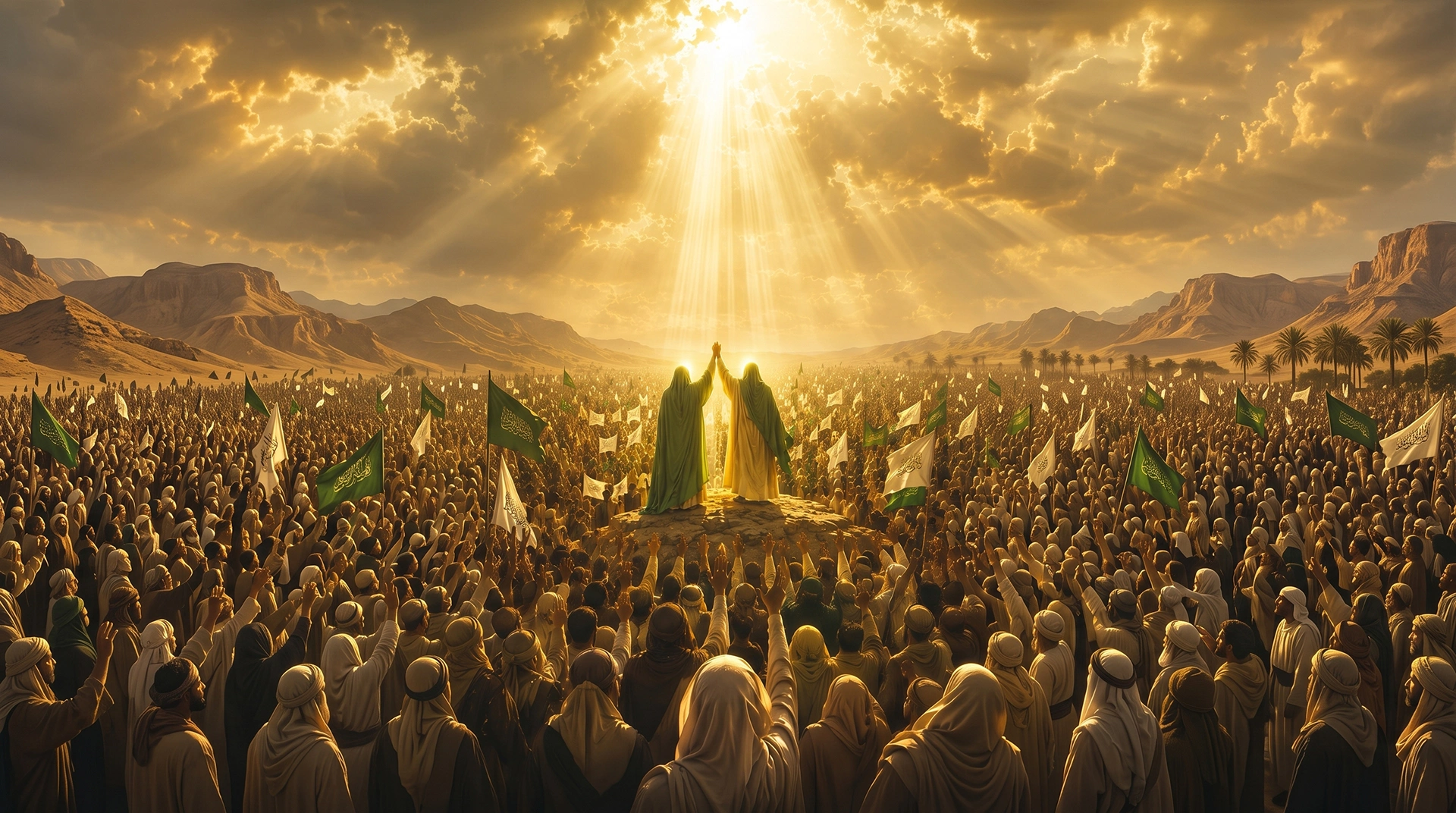
The Prophet ordered those who had gone ahead to return and waited for those who were still traveling behind. A gathering was established at Ghadir Khumm, and a platform was prepared for the Prophet to address the people.
The event is recorded in multiple classical Islamic sources, and its historic occurrence is broadly recognized, although Muslims have differed over the meaning and implications of the Prophet’s declaration concerning Imam Ali.
The Prophet then spoke to the gathered Muslims about his relationship with them and asked whether he had greater authority over the believers than they had over themselves.
When they affirmed this, he took Imam Ali and declared:
“For whoever I am his mawla, Ali is his mawla.”
This statement, known as the Hadith of Ghadir, became one of the most important traditions concerning Imam Ali. It is also recorded in sources including al-Tirmidhi.
The Meaning of Mawla
The central question surrounding Ghadir Khumm concerns the meaning of the Arabic word mawla.
In Shia Islam, the declaration is understood as the Prophet formally establishing Imam Ali’s wilayah and leadership after him. From this perspective, Ghadir represents the Prophet’s designation of Ali as his successor and the continuation of divine guidance through the Ahl al-Bayt.
Sunni scholars and traditions generally accept the historical occurrence of the declaration but interpret mawla differently, commonly emphasizing Ali’s friendship, loyalty, honor, and special status rather than an explicit appointment to political succession.
This difference in interpretation became one of the most important points of theological discussion in Islamic history.
A Declaration of Wilayah
For Shia Muslims, Ghadir Khumm is far more than an expression of affection toward Imam Ali.
The Prophet’s question about his authority over the believers immediately before declaring Ali’s mawla status gives the statement a deeper meaning. Shia interpretation understands this as a declaration of wilayah—Ali’s spiritual authority and leadership over the Muslim community.
The event is therefore regarded as a defining moment in the history of Imamate.
Imam Ali’s Unique Position
Ghadir was not the beginning of Imam Ali’s importance. Throughout the Prophet’s life, Ali had already demonstrated extraordinary closeness to him.
He was the Prophet’s cousin and son-in-law, among the earliest believers, a defender of Islam, and a central figure in the early Muslim community.
The declaration at Ghadir, however, placed his position before a large gathering at a critical moment near the end of the Prophet’s life. For Shia Muslims, this made Ghadir the culmination of Ali’s relationship with the Prophet and the formal announcement of his future role.
Ghadir and the Ahl al-Bayt
The message of Ghadir is also closely connected with the Prophet’s emphasis on his Ahl al-Bayt, or household.
The traditions surrounding Ghadir preserve the Prophet’s concern for the Qur’an and his family, making the event part of a broader message about remaining connected to divine guidance and the Prophet’s household.
For Shia Muslims, this connection is fundamental to understanding the role of Imam Ali and the Imams who came from his family.
Eid al-Ghadir
The significance of Ghadir continues to be commemorated every year.
18 Dhu al-Hijjah is celebrated as Eid al-Ghadir by Shia Muslims. It is regarded as a day of great spiritual significance and as the anniversary of the Prophet’s declaration concerning Imam Ali.
The day is marked with prayers, gatherings, celebrations, and remembrance of the Prophet’s message.
A Moment That Shaped Islamic History
Ghadir Khumm stands as one of the most discussed events in Islamic history because its significance extends beyond the gathering itself.
For Shia Muslims, it represents the Prophet’s declaration of Imam Ali’s leadership and the foundation of the doctrine of Imamate. More broadly, the event remains an important part of the historical record of the Prophet’s final years and the question of leadership after his death.
The words spoken at Ghadir have been remembered for more than fourteen centuries, shaping religious thought, scholarship, and devotion across generations.
The Legacy of Ghadir
Ghadir Khumm remains a powerful reminder of Imam Ali’s unique place in Islamic history.
For those who follow the Shia understanding of the event, it was the day when the Prophet publicly declared Ali as the mawla of the believers and established his position as the successor and Imam after him.
Ghadir was not simply a moment on a journey home. It became a defining moment in the story of Islam—one declaration that would shape the understanding of leadership, authority, and the Ahl al-Bayt for generations to come.