The Shrine of Imam Ali in Najaf: History, Architecture & Ziyarat
If Shia Muslims were to identify a place as one of the spiritual centers of their world, Najaf would undoubtedly stand among the most important. At the heart of the city stands the Shrine of Imam Ali ibn Abi Talib, a sacred destination that has drawn pilgrims, scholars, and visitors from across the world for centuries.
For Shia Muslims, Najaf is not simply a city. It is a place deeply connected with the life, martyrdom, legacy, and teachings of Imam Ali. The shrine surrounding his traditional burial place has become one of the most important pilgrimage sites in the Islamic world and has played a central role in the development of Najaf as a center of Islamic scholarship.
From its hidden burial place and centuries of development to its golden dome, courtyards, sacred chambers, and traditions of ziyarat, the Shrine of Imam Ali contains layers of history, faith, architecture, and devotion.
Where Is the Shrine of Imam Ali?
The Shrine of Imam Ali is located in Najaf, Iraq, approximately 80 kilometers south of Karbala. Najaf lies near the ancient region of Kufa and has long been associated with Islamic learning and pilgrimage.
The city became especially prominent after the traditional burial place of Imam Ali became known and a shrine was gradually established around it.
Today, Najaf is the capital of Najaf Governorate and is one of the most important religious cities in Iraq. Alongside its importance as a pilgrimage destination, it has been renowned for centuries as a center of Islamic scholarship.
The growth of the shrine and the city of Najaf have been closely connected. As pilgrims increasingly traveled to visit Imam Ali, religious schools, libraries, seminaries, markets, and residential areas developed around the sanctuary.
Several rulers and patrons contributed to the development of Najaf and its shrine over the centuries, including rulers of the Safavid dynasty and later Iranian rulers.
The Hidden Burial of Imam Ali
The history of the shrine begins with an unusual tradition surrounding the burial of Imam Ali.
After Imam Ali was struck by Ibn Muljam in the mosque of Kufa and later died from his wounds in 40 AH (661 CE), he was secretly buried according to traditions preserved in Shia sources.
According to these accounts, Imam Ali had instructed that his burial place should remain concealed. His sons, Imam Hasan and Imam Husayn, along with Muhammad ibn al-Hanafiyyah, are traditionally said to have participated in his burial.
The reason given for concealing the grave was fear that enemies of Imam Ali, particularly the Kharijites, might desecrate or destroy his burial place.
For a period, therefore, the exact location of his grave remained known only to a small number of people.
According to Shia tradition, the location eventually became publicly known after the political circumstances that had made the concealment necessary had changed.
The shrine was not built in its present form at a single point in history. Rather, the sanctuary developed gradually through successive periods of construction, restoration, decoration, and expansion.
Traditional accounts attribute some of the earliest construction around Imam Ali’s grave to the Abbasid caliph Harun al-Rashid. Later structures were built or renovated by different rulers and patrons.
One of the most significant periods in the development of the shrine came during the Buyid period, particularly under Adud al-Dawla, whose patronage contributed greatly to the development of Najaf and the sanctuary.
The Safavid period brought another important phase of architectural development. Shah Tahmasp I contributed to the construction and decoration of the shrine, while later Safavid rulers continued its development.
Shah Abbas I undertook major work on the sanctuary, and the celebrated Iranian scholar and architect Shaykh Baha’i is traditionally associated with aspects of its architectural design.
Later, Nader Shah Afshar ordered the gilding of important parts of the shrine, including the dome and minarets.
The sanctuary has continued to undergo restoration and expansion in more recent periods.
The Golden Dome of Imam Ali
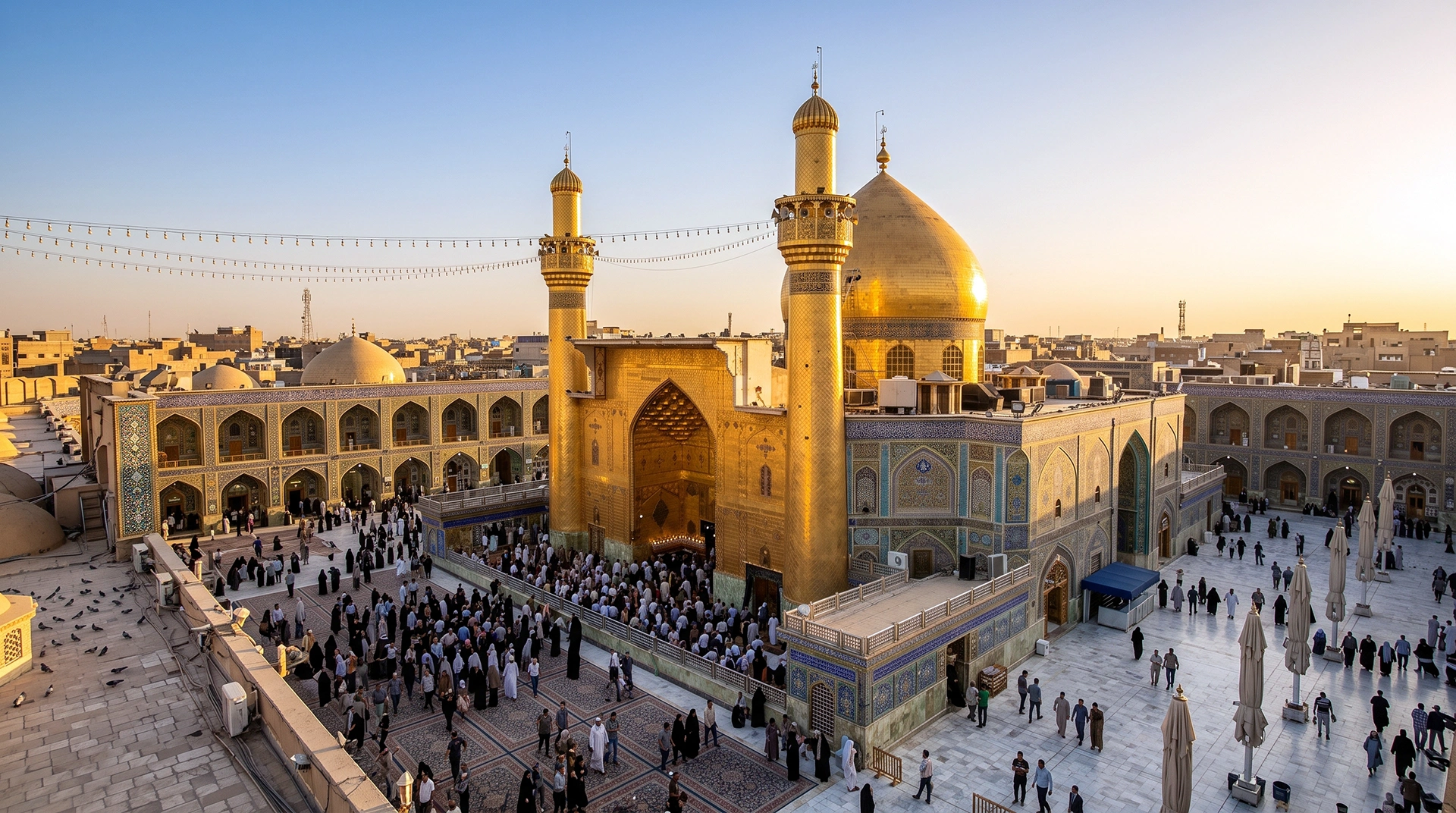
The Golden Dome is perhaps the most recognizable symbol of Najaf.
Rising above the shrine, the dome can be seen from different parts of the city and has become an enduring visual symbol of Imam Ali and Najaf.
Its golden surface reflects centuries of craftsmanship and restoration. Together with the golden minarets and the Golden Iwan, it forms the architectural centerpiece of the shrine.
For pilgrims, however, the dome represents more than architectural beauty. Seeing it for the first time is often an emotional moment, particularly for those who have traveled long distances to perform ziyarat.
The sight of the golden dome above Najaf has become deeply associated with arrival, pilgrimage, remembrance, and devotion to Imam Ali.
Architecture of the Shrine of Imam Ali
The architecture of the shrine reflects several centuries of Islamic art and craftsmanship.
Its complex incorporates numerous artistic traditions, including:
Gold-covered architectural elements
Intricate tilework
Mirror work
Stucco decoration
Enamel work
Wood carving
Mosaic and decorative craftsmanship
Qur’anic inscriptions
Islamic geometric patterns
Ornamental doors and ceilings
The dome, minarets, iwans, courtyards, and covered passageways create a complex architectural environment in which different historical periods can be seen together.
Many of the surfaces are decorated with Qur’anic verses, religious inscriptions, floral patterns, and geometric designs.
The result is an architectural style in which religious devotion and artistic expression are closely intertwined.
The Rawdah: The Heart of the Shrine
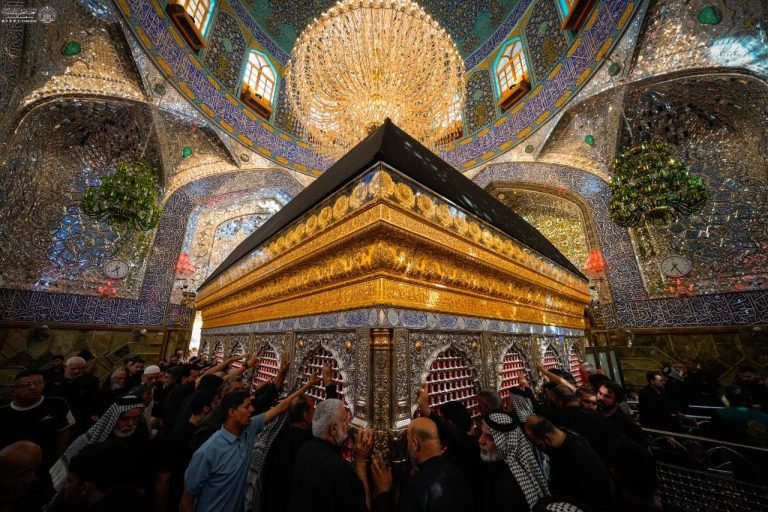
At the center of the sanctuary is the Rawdah, the area surrounding the sacred tomb of Imam Ali.
This is the spiritual heart of the shrine and the place where pilgrims come to offer greetings, recite ziyarat texts, pray, and spend time in personal devotion.
The area around the tomb is richly decorated and carefully maintained. Pilgrims gather beneath the dome to perform prayers and supplications and to remember the life and teachings of Imam Ali.
For many visitors, this is the most significant part of their entire journey to Najaf.
The Riwaqs of the Shrine
Surrounding the Rawdah are covered halls and passageways known as riwaqs.
These spaces provide areas for prayer, reflection, Qur’anic recitation, and other acts of worship.
The decorated ceilings, columns, walls, and entrances contribute to the distinctive atmosphere of the sanctuary.
For pilgrims, the riwaqs also provide a quieter space away from the busiest areas surrounding the tomb.
The Iwans of the Shrine
The shrine contains several important iwans, or monumental vaulted halls.
Among the best known is the Golden Iwan, which has become one of the most recognizable features of the sanctuary.
Other important iwans include the northern iwan, the southern or Great Iwan, the Iwan of the Scholars, and the Golden Gutter Iwan.
The Golden Iwan in particular is a favorite place for pilgrims to pause, pray, and admire the architecture of the shrine.
The Doors of the Shrine
The sanctuary has historically been accessed through several important gates, each carrying its own name and historical associations.
Among the traditional names associated with the shrine’s entrances are:
Bab al-Kabir
The Great Gate, or Bab al-Kabir, opens toward the market area and is one of the principal entrances to the sanctuary. A clock is positioned above the entrance.
Bab Muslim ibn Aqil
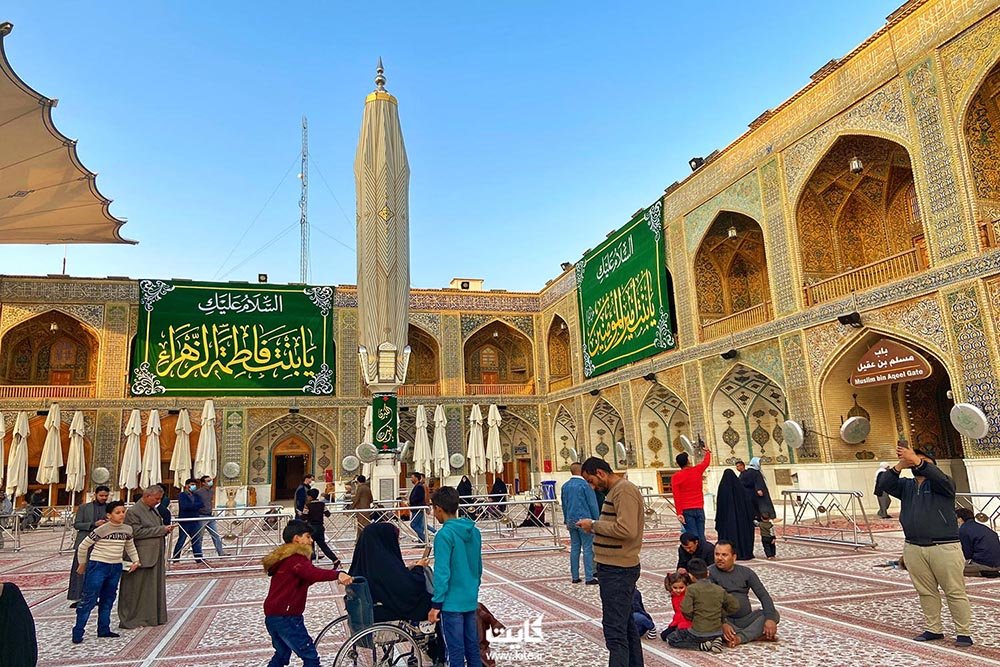
Named after Muslim ibn Aqil, a close relative and representative of Imam Husayn, this gate is located near Bab al-Kabir.
Bab al-Tusi
This gate is associated with Shaykh al-Tusi, one of the most influential scholars in the history of Shia Islamic scholarship.
Bab al-Qiblah
The Qiblah Gate faces the direction of prayer and is another important entrance to the shrine complex.
Bab al-Sultani / Bab al-Faraj
This entrance is traditionally associated with the route toward the area known as the Maqam of Imam al-Mahdi.
The Tomb and Zarih of Imam Ali
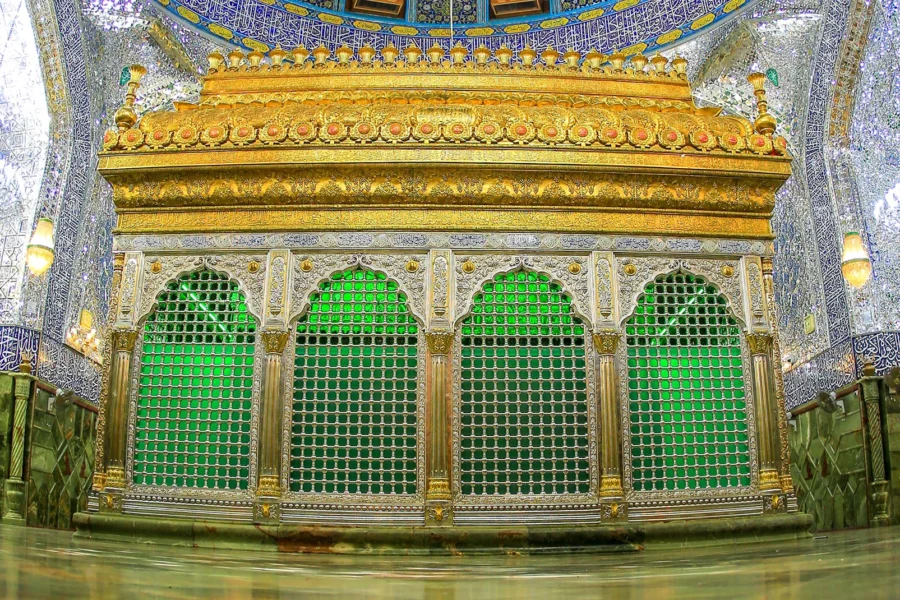
At the center of the Rawdah stands the Zarih, the ornate enclosure surrounding the traditional burial place of Imam Ali.
The Zarih has undergone different forms and reconstructions throughout the history of the shrine. The present structure incorporates elaborate metalwork, including gold and silver elements, together with intricate decorative patterns and inscriptions.
For pilgrims, standing before the Zarih is the central moment of ziyarat.
They offer greetings to Imam Ali, recite traditional ziyarat prayers, make personal supplications, and remember his life and teachings.
Masjid al-Ra’s and the Maqam of Imam Ja’far al-Sadiq
On the western side of the shrine complex is Masjid al-Ra’s, a mosque associated with traditions concerning the head of Imam Husayn following the tragedy of Karbala.
According to traditional accounts, the head of Imam Husayn was brought to this location before being taken onward.
The mosque is also associated with the Maqam of Imam Ja’far al-Sadiq. According to tradition, Imam Ja’far al-Sadiq prayed at this location during his visit to the shrine of his grandfather, Imam Ali.
These traditions have given the mosque an additional significance for pilgrims visiting Najaf.
Who Is Buried at the Shrine of Imam Ali?
The shrine is traditionally associated not only with Imam Ali but also with the graves of other revered figures.
According to Shia tradition, Prophet Adam and Prophet Noah (Nuh) are also buried at or near the sacred site associated with Imam Ali.
The wider sanctuary and surrounding cemetery of Najaf also contain the graves of numerous scholars, religious figures, and prominent personalities.
Among the figures traditionally associated with the shrine or its surrounding sacred area are:
Kumayl ibn Ziyad
Allamah al-Hilli
Mulla Ahmad Naraqi
Other prominent scholars and religious figures
The presence of generations of scholars has contributed to Najaf’s identity as both a city of pilgrimage and a center of Islamic learning.
The Courtyards of the Shrine
The shrine complex includes large courtyards that provide space for pilgrims to gather, pray, and move between different parts of the sanctuary.
The main historic courtyard was significantly developed during the Safavid period.
In more recent decades, the shrine complex has undergone major expansion projects to accommodate the growing number of pilgrims.
One of the most significant developments is the Sahn of Lady Fatimah al-Zahra, a large expansion project designed to provide additional space and facilities for visitors.
These expansions reflect the continuing importance of Najaf as an international pilgrimage destination.
The Shrine as a Center of Ziyarat
Every year, pilgrims travel to Najaf from across Iraq and from countries around the world.
They come for ziyarat—to offer greetings to Imam Ali, recite prayers, remember his life, and seek spiritual renewal.
For some visitors, the journey is carefully planned for years. For others, it is an unexpected opportunity to visit a place they have long hoped to see.
People arrive with different intentions. Some pray for their families. Some seek guidance or forgiveness. Others simply want to stand beneath the Golden Dome and spend a few moments in remembrance of Allah.
The experience of ziyarat is therefore deeply personal.
The Spiritual Significance of the Shrine
The Shrine of Imam Ali is more than a historical monument or architectural landmark.
For millions of Shia Muslims, it is a place associated with faith, remembrance, prayer, and spiritual connection.
Visitors often describe a sense of peace and reflection when entering the sanctuary. The sound of Qur’anic recitation, prayers, and the movement of pilgrims creates an atmosphere very different from ordinary daily life.
The shrine provides an opportunity to pause and reflect on the qualities for which Imam Ali is remembered: justice, courage, knowledge, worship, humility, and devotion to Allah.
For believers, visiting the shrine can therefore become not only a physical journey to Najaf but also an inward journey toward reflection and spiritual renewal.
Why Najaf Holds a Special Place in Shia Islam
The identity of Najaf is inseparable from the Shrine of Imam Ali.
Over centuries, the city developed around two closely connected roles: a city of pilgrimage and a city of knowledge.
Scholars from different parts of the Muslim world traveled to Najaf to study Islamic sciences. Religious seminaries and scholarly institutions developed around the sanctuary, making Najaf one of the most important centers of Shia learning.
At the same time, millions of pilgrims continued to arrive to visit Imam Ali.
This combination of scholarship and devotion gives Najaf a distinctive place in Islamic history.
A Place Where the Heart Feels at Home
The Shrine of Imam Ali is remembered not only for its golden dome, magnificent architecture, or centuries of history.
Its deepest significance lies in what it represents.
It represents a connection with a man whose life has inspired generations through his faith, courage, knowledge, justice, and devotion to Allah.
For those who have spent years hoping to visit Najaf, seeing the Golden Dome can be an unforgettable moment.
For those standing before the Zarih, the experience can feel deeply personal.
And for generations of pilgrims, Najaf has been more than a destination.
It has felt like coming home.
Conclusion
The Shrine of Imam Ali stands at the heart of Najaf as a remarkable meeting point of faith, history, scholarship, architecture, and pilgrimage.
Its story began with the hidden burial of Imam Ali and continued through centuries of construction, restoration, artistic development, and devotion. Its Golden Dome, iwans, courtyards, riwaqs, inscriptions, and sacred spaces preserve the legacy of generations who dedicated themselves to honoring Imam Ali.
For pilgrims, however, the true importance of the shrine cannot be measured by its architecture alone.
It is a place to remember Imam Ali, reflect upon his teachings, offer prayers, and seek closeness to Allah.
Under the Golden Dome of Najaf, a journey that begins with the feet can become a journey of the heart.
The sacred site of Imam Ali in Najaf is traditionally associated with the resting places of Imam Ali, Prophet Adam, and Prophet Noah. For Shia Muslims, this makes the shrine a unique place where the legacy of three revered figures comes together.

 Shrine & Ziyarat