
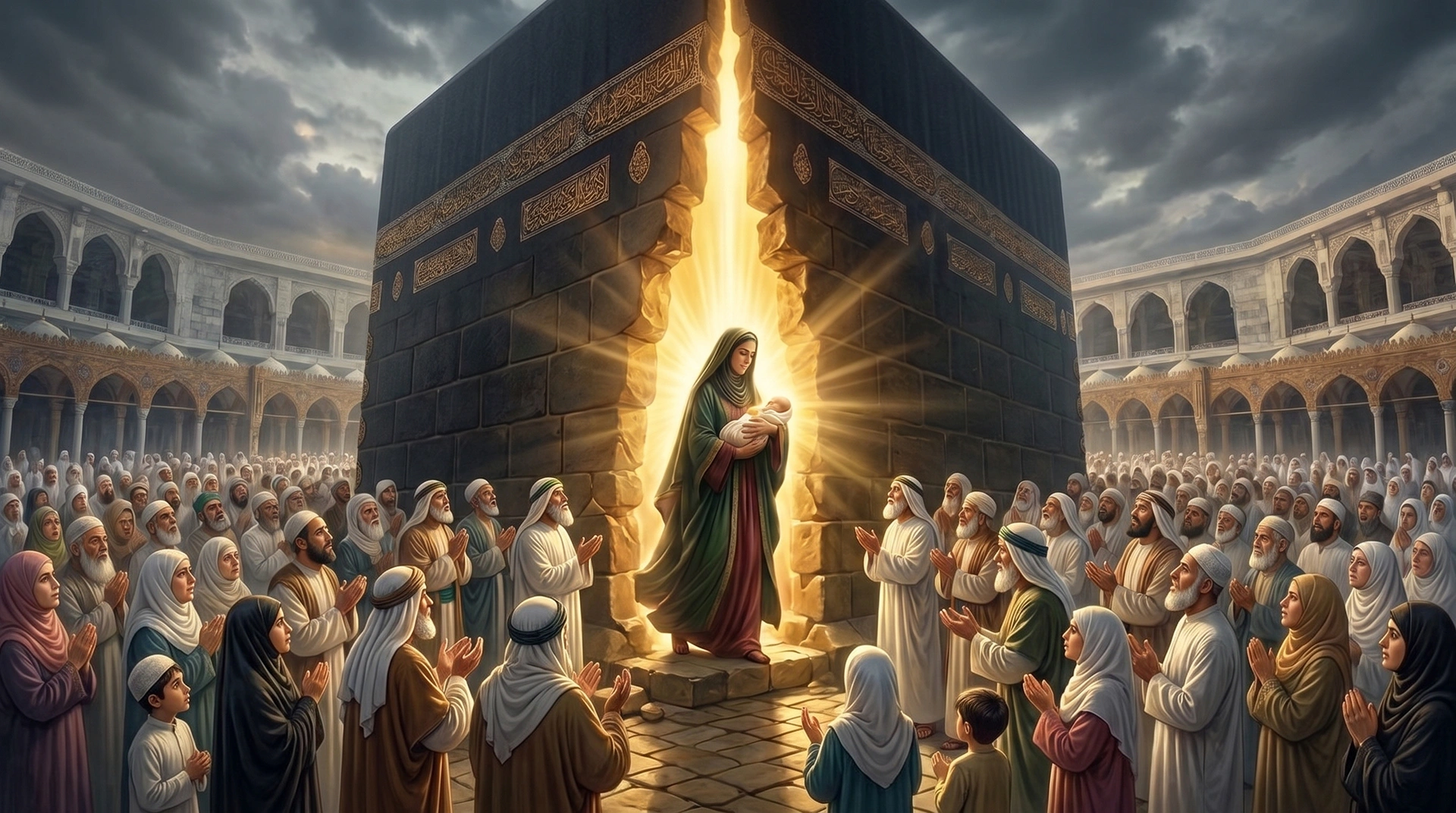
Imam Ali’s Birth in the Kaaba — The Story of 13 Rajab
On the thirteenth day of Rajab, the blessed month known for divine mercy and grace, Imam Ali ibn Abi Talib was born. It was a day on which, according to Islamic tradition, God bestowed a great blessing upon the heavens and the earth by bringing Ali into the world.
For centuries, 13 Rajab has been honored by Shia Muslims and lovers of the Ahl al-Bayt, who commemorate the birth of Imam Ali each year through religious gatherings and celebrations.
The life of Imam Ali was extraordinary and filled with events that left a lasting mark on Islamic history. According to numerous traditional accounts, even his birth was accompanied by remarkable signs, pointing to the arrival of one of the greatest figures in Islamic history.
But what do traditional sources say about the birth of Imam Ali?
The Story of Imam Ali’s Birth
According to widely transmitted Islamic traditions, on 13 Rajab in the 30th year of the Year of the Elephant, an extraordinary event took place—an event regarded as unprecedented in human history.
Imam Ali was born inside the Holy Kaaba.
According to a narration transmitted by Sa’id ibn Jubayr from Yazid ibn Qanab, Yazid said:
“I was sitting with Abbas ibn Abd al-Muttalib and a group of the descendants of Abd al-Uzza in front of the Kaaba when Fatimah bint Asad, the mother of Amir al-Mu’minin Ali, appeared. She was nine months pregnant and had begun experiencing labor pains.”
Fatimah bint Asad then prayed:
“My Lord, I believe in You, Your prophets, and the Books You have revealed. I affirm the words of my grandfather Ibrahim al-Khalil, who built this Ancient House. By the One who built this House, and by the child whom I carry in my womb, make the birth of this child easy for me.”
Yazid ibn Qanab continues:
“We saw the House of God split open from the rear side, at the place known as al-Mustajar. Fatimah entered the House, and we could no longer see her. The wall then returned to its original state.”
Those present reportedly attempted to open the door of the Kaaba, but the lock would not open. They therefore understood the event as an extraordinary act by God.
Fatimah bint Asad Emerges from the Kaaba
According to the narration, Fatimah bint Asad remained inside the Kaaba for three days before emerging while carrying her newborn son, Ali.
She is reported to have said that she had been granted a special distinction among the women of the past. She referred to Asiya, who worshipped God secretly under difficult circumstances, and Maryam (Mary), daughter of Imran, who was provided with fresh dates during her labor.
Fatimah bint Asad then said that she had entered the House of God and been provided with fruits and blessings from Paradise.
Where Is the Rukn al-Yamani in the Kaaba?
The Rukn al-Yamani, or Yemeni Corner, is one of the four corners of the Kaaba. It is located on the southwestern side of the Kaaba, before the Black Stone when proceeding around the Kaaba in the direction of tawaf.
The Rukn al-Yamani is also associated in Islamic tradition with the events surrounding the birth of Imam Ali.
A narration attributed to Imam Muhammad al-Baqir states that the Prophet Muhammad would touch the Yemeni Corner and the Black Stone, kiss them, and place his face against them.
Imam Ja’far al-Sadiq is also reported to have said that the Yemeni Corner is one of the gates of Paradise and that, once opened, it would not be closed.
According to this tradition, supplication made by a believer beside the Yemeni Corner rises toward God without a barrier between the prayer and the Divine Presence.
How Was Imam Ali Given His Name?
The traditional account states that because the birth of Imam Ali was itself regarded as a divine miracle, his name was also given by divine command.
Fatimah bint Asad is reported to have said:
“When I wanted to leave [the Kaaba], a voice called to me from the unseen: ‘O Fatimah, name him Ali, for he is Ali, and God is al-Ali al-A’la (the Most High). He says: I have derived his name from My own name, educated him according to My own manners, and entrusted him with the profound knowledge of My mysteries. He is the one who will call to prayer from above My House and will glorify and praise Me. Blessed is the one who loves him and obeys him, and woe to the one who opposes him and disobeys him.'”
The name Ali means “high,” “exalted,” or “noble,” and is traditionally connected with the Divine Name al-Ali, meaning “the Most High.”
Is Imam Ali the Only Person Born Inside the Kaaba?
It is widely held in Shia tradition that Imam Ali is the only person to have been born inside the Kaaba, and that this distinction was exclusively granted to him by God.
According to this belief, no one was born inside the Kaaba either before or after Imam Ali. His birth inside the sacred sanctuary is therefore regarded as one of his greatest virtues and a sign of his unique spiritual position.
A number of prominent Muslim scholars, from both Sunni and Shia traditions, have mentioned the birth of Imam Ali inside the Kaaba.
Al-Hakim al-Nishapuri
The renowned Sunni scholar al-Hakim al-Nishapuri is reported to have regarded the reports concerning the birth of Imam Ali inside the Kaaba as widely transmitted. He stated that reports had reached the level of tawatur that Fatimah bint Asad gave birth to Ali ibn Abi Talib inside the Kaaba.
Hafiz al-Kanji
Hafiz al-Kanji, a Sunni scholar who died in 658 AH, wrote that Amir al-Mu’minin Ali was born inside the House of God on Friday night, the thirteenth of Rajab, in the thirtieth year after the Year of the Elephant.
He further stated that no one had been born inside the Kaaba before or after Imam Ali and described this as one of his unique virtues, granted by God as an honor to his elevated position.
Ibn al-Sabbagh al-Maliki
Ibn al-Sabbagh al-Maliki, who died in 855 AH, also recorded a similar account in his work al-Fusul al-Muhimmah, describing the birth of Imam Ali inside the Kaaba.
Shahab al-Din al-Alusi
Shahab al-Din al-Alusi, the renowned Islamic scholar and commentator, also discussed the tradition concerning Imam Ali’s birth inside the Kaaba.
While commenting on a famous poetic description of Imam Ali’s birth, he acknowledged that the account of Ali being born inside the Kaaba had become widely known and had been recorded in both Sunni and Shia sources.
He also noted that he was unaware of anyone else whose birth inside the Kaaba had been reported in the same manner, describing it as a remarkable honor for Imam Ali to have been born in the place that serves as the direction of prayer for Muslims.
Shaykh al-Mufid
The prominent Shia scholar Shaykh al-Mufid stated that no one other than Imam Ali had been born inside the Kaaba, either before or after him. He regarded this as an honor and distinction granted to Imam Ali by God because of his elevated status.
The Significance of Imam Ali’s Birth in the Kaaba
The birth of Imam Ali inside the Kaaba occupies a special place in Islamic tradition, particularly in Shia thought. It is regarded as one of the remarkable signs associated with his life and as a reflection of his unique position among the Ahl al-Bayt.
For Muslims who honor Imam Ali, the story of his birth is more than an extraordinary historical account. It represents the beginning of the life of a man remembered for his faith, courage, justice, knowledge, devotion, and leadership.
From his close relationship with Prophet Muhammad to his role as the fourth caliph in Sunni historical tradition and the first Imam in Shia tradition, Imam Ali became one of the most influential figures in Islamic history.
His birth in the Sacred House is therefore remembered as a remarkable beginning to the life of a man whose teachings, character, and legacy have continued to influence generations of Muslims.